
Why dose, administration volume, treatment duration, dosing frequency, patient population, indication and route of administration matter in E&L patient-exposure assessment.
An E&L risk assessment is incomplete without understanding the patient exposure context. A chemical source may exist, but the significance of that source depends on how much of a potential leachable could reach the patient and under what clinical conditions.
Performing an exposure assessment and generating a multifactorial risk matrix using LeachScan.
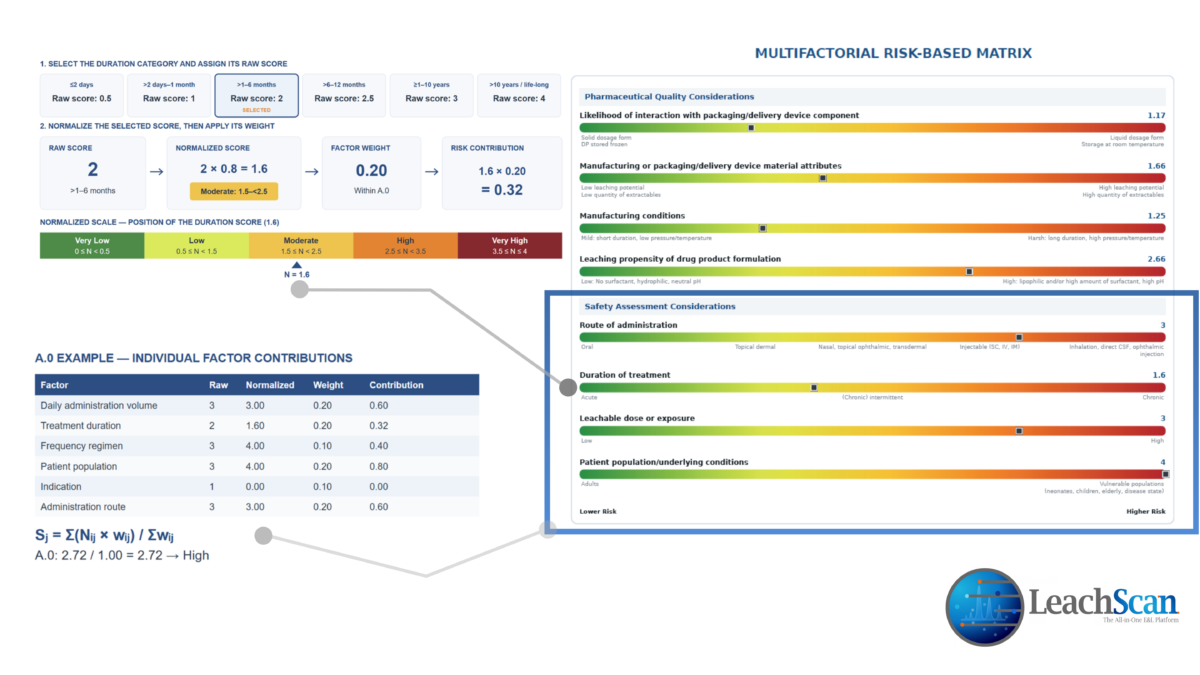 Treatment duration and dosing frequency
Acute, intermittent and chronic exposure scenarios do not create the same toxicological context. Duration and frequency affect both the cumulative exposure scenario and the safety framework that may be relevant.
Maximum daily exposure basis
The relevant product dose or administration volume helps translate a chemical concentration into potential patient exposure. The appropriate basis depends on the dosage form and how the product is administered.
Patient characteristics can affect the level of concern. Vulnerable populations may require additional consideration because of developmental stage, disease state or other physiological factors.
Route of administration
Route can influence systemic availability, local exposure and the relevance of specific toxicological endpoints. Parenteral, inhalation, ophthalmic, oral, dermal and other routes should not automatically be assumed to be equivalent.
Why this belongs in risk assessment
The same material or compound can have different significance in products with different dose, route, duration or patient populations. Exposure context is therefore one of the essential dimensions used to determine the appropriate depth of E&L assessment and safety evaluation.
Frequently asked questions
Why does maximum daily dose matter in E&L?
It helps convert a chemical level in the product into a potential patient exposure.
Does treatment duration affect the E&L assessment?
Yes. Acute and chronic exposure scenarios can differ in toxicological significance and applicable safety considerations.
Why is route of administration important?
Route affects systemic availability, local tissue exposure and the relevance of route-specific toxicity.
Should vulnerable populations be considered?
Yes, where relevant to the intended product population.
Is patient exposure alone enough to determine E&L risk?
No. It must be integrated with material, interaction, manufacturing, formulation and compound-specific information.
Related Altox technology
GATE is a module in LeachScan software that supports this part of the E&L workflow at a high level. Proprietary weights, scores, algorithms, cutoffs, equations and decision rules are not disclosed on this public page.